About
Biography
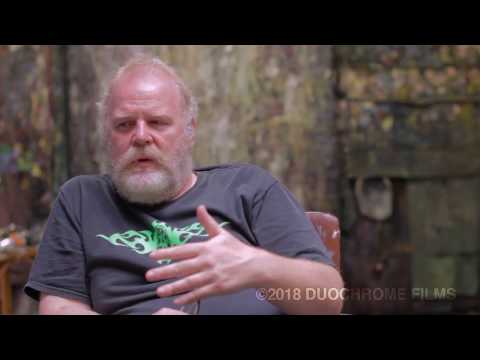
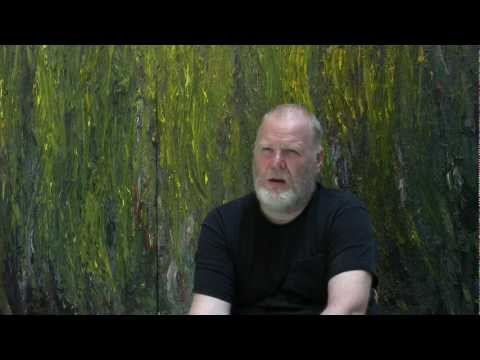
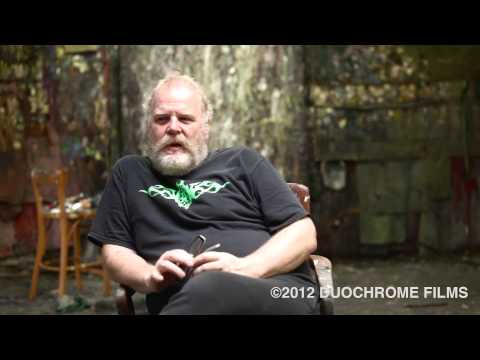
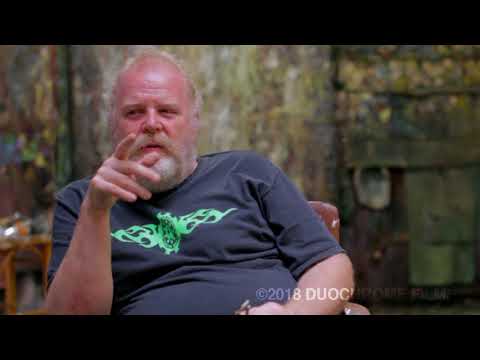
Born in Northern Ireland in 1956, Rodney Dickson grew up during the period of social and political unrest known as 'The Troubles.' At the age of 23 he left Northern Ireland to study art in Liverpool Art School. Drawing and painting since childhood, he knew on his first day of college that he would be an artist and has continued since then.
"Growing up during The Troubles affected all of us who survived those times. Many people developed a critical view of society, religion and politics in general. In my case, I found the freedom to express myself as an artist, an outsider."
Critical Review
I have known Rodney Dickson and his work since he was a raw, young art student at Liverpool, fresh from what was then a troubled and often violent Northern Ireland. I think of him now, as I did then, as "driven", driven by an insatiable desire for art, making, looking, studying, talking.
Based now, and for many years, in Brooklyn N.Y., he is also an inveterate traveller. His work and curiosity in cultures other than his own have led him to the East and Far East, India, mainland China, Taiwan, Cambodia and Vietnam, in the West to Devon U.K., Amsterdam, Berlin and Iceland and probably more, - but all have had an impact on his work and his belief in a shared human experience.
I regard him primarily as a painter, as I believe he does himself, but this should not distract from his exciting forays into installation, assemblage, collage and printmaking, his continuous need to experiment and to surprise himself.
In recent years he has concentrated almost exclusively on drawing and painting. It has been said elsewhere that ultimately all painting is a self portrait, evident, I believe in all of Rodney’s work, the passages of anger and frustration, insight, invention, impulse and contemplation, yet all underpinned by a rigorous intellect which allows him no evasion.
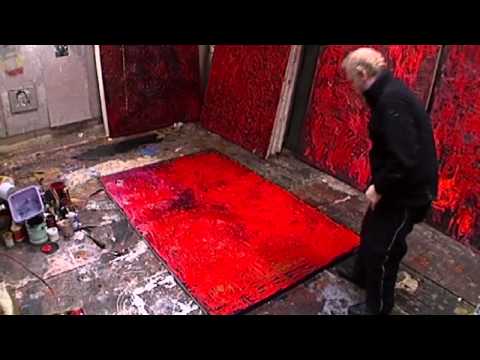
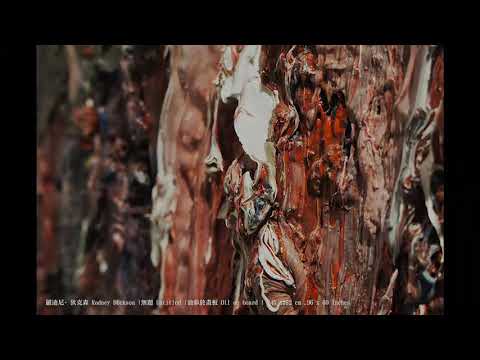
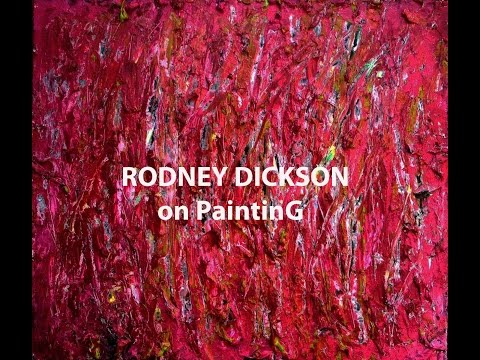
He is absorbed in the physical properties and language of paint, paint as a metaphor for his deepest feelings. He works often on a large but human scale over which he can reach at arm’s length keeping the paint moving with a fluidity which seeks to equate with that of Nature itself, shifting seasons, light and weather. Essentially much of this work takes place in the studio, paintings as much about the act of painting as anything else and dependant on an impressive quantity of materials. Yet from time to time Rodney works outside in extremes of weather and light, experiences which must feed indirectly into the studio work without any tendency to direct representation while inevitably merging with the artist’s inner landscape.
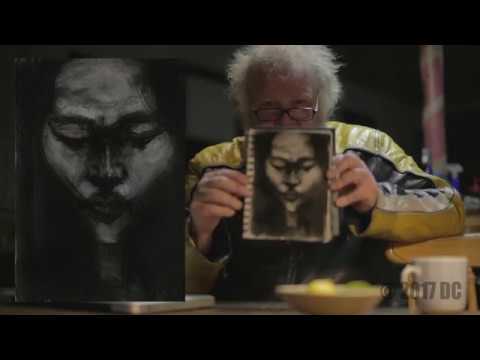
Parallel to this approach has been a long series of overtly descriptive images of the human figure going back to his early Liverpool career and haunting images of the tragic snooker player Alex "Hurricane" Higgins with whom he shared a background, early life and experiences in Northern Ireland. More recently we see an ongoing series of "portraits" based on photographs supplied by friends and acquaintances, long, white robed, vertical figures which concentrate fiercely on the eyes, not least because most are masked reflecting the Covid years. If all we knew of Rodney Dickson was this remarkable series it would still mark him as a painter of distinction.
Throughout his career Rodney’s work has been underpinned by the practice of drawing as often as not from life, including drawings and sometimes paintings of those of his friends with the patience or endurance to sit for him. I think that all his drawings are made for himself, not the viewer, and are an essential part of his diet.
This is a rare artist, a painter of substance, brave, adventurous and wholly committed, an artist who has produced memorable images in a range of media and will no doubt continue to do so. He and I have exchanged images and thoughts across the years, a correspondence which has enlivened my advancing years. I hope to live to see his work reach an ever widening public as it certainly will and most certainly deserves.
Mike Knowles,
Anglesey 23/07/21.
A Wee Fish, 1997, 9 x 6 inches, oil on canvas on board.
"Rodney, it’s hard for me to be critical as I know how much goes into your work, and I’ve always loved your painting, so you’ve got a biased opinion! You could paint a pair of socks and it would be good, haha" — David Liddell
Rodney Dickson: Existential Painting
Rodney Dickson occupies an interesting position within contemporary painting.
Although he has lived in New York for decades, he is not fundamentally a “New York School” painter. Rather, he brings together three artistic and historical trajectories, the legacy of Northern Irish conflict, American Abstract Expressionism, and a deeply European conception of painting as an existential practice.
Rodney was born in Belfast in 1956 and grew up during The Troubles. He left Northern Ireland to study at Liverpool Art School before eventually settling in Brooklyn in 1997. His biography is not incidental, it forms the psychological substrate of nearly everything he paints. Dickson himself has repeatedly described violence, political hypocrisy, and the lingering effects of war as the point from which his work originates. His long engagement with Vietnam and Cambodia broadened this inquiry from a specifically Irish experience into a more universal meditation.
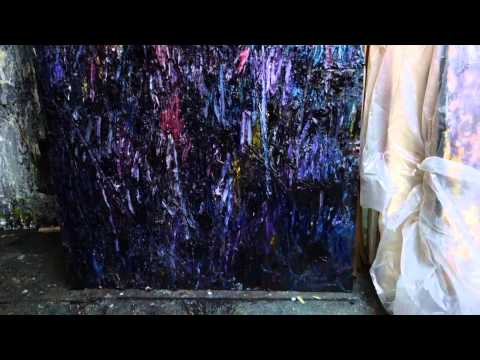
Looking across his oeuvre, one notices that Dickson is less interested in depicting objects than in recording the physical event of painting itself. His canvases are built through: * repeated scraping * thick impasto * drips * erasures * overpainting. The finished painting evolves from the residue of prolonged struggle rather than as a preconceived composition.
His brushwork frequently feels interrupted, wounded or unstable, instead of heroic action, one encounters hesitation, abrasion and reconstruction. This gives his paintings an ethical dimension, as the surface bears witness to damage. In this respect his work shares affinities with * Anselm Kiefer * Leon Kossoff * Frank Auerbach where painting becomes an excavation from life rather than an aesthetic achievement.
An important quality of Dickson’s work is its oscillation between abstraction and figuration. Many paintings begin as recognisable subjects: * figures * portraits * landscapes yet they dissolve into painterly matter. Conversely, many abstract works seem haunted by bodies or faces emerging from the paint. This ambiguity recalls * Francis Bacon * Jean Fautrier * Antoni Tàpies where the image never fully stabilises.
“painting is painting and you get there any way you can.”
One of Dickson’s greatest strengths is his understanding and confidence in the possibilities of paint as a material. Paint is never merely descriptive, it possesses boundless potential as a path to somewhere beyond. The paintings communicate without narrative, aligning him with twentieth-century European painters for whom painting itself constitutes the primary language.
His portrait paintings, especially those made during and after the COVID period, superficially differ from his abstractions but essentially continue his belief in the possibilities of painting as a means of transcendence. Faces emerge with remarkable psychological intensity while remaining partially obscured by painterly dissolution. The eyes frequently become the only stable point within otherwise unstable surfaces. Here one can detect echoes of * Bacon * Lucian Freud although Dickson avoids Freud’s forensic realism, instead, identity appears fragile and provisional.
Unlike many painters rooted exclusively in Western traditions, Dickson spent decades traveling and working in the east, especially Vietnam, Cambodia, Taiwan and China. These experiences did not lead him to adopt East Asian visual languages superficially, rather, they expanded his understanding of painting.
Rodney Dickson belongs to a generation of painters who continued to believe in the relevance of painting after the conceptual turn of the 1970s and 1980s. His work resists several dominant tendencies: * it is not ironic * not overtly theoretical * not digitally mediated * not market-driven * not decorative abstraction. Instead, it insists that painting remains capable of carrying historical, psychological and moral complexity. This perhaps explains why his career developed somewhat outside the most fashionable institutional narratives while earning sustained recognition through galleries, museum collections, awards such as the Pollock-Krasner Foundation and support from institutions such as PS1 MOMA.
Conclusion
Rodney Dickson can be understood as an heir to post-war existential painting.
Videos & Interviews